Arthritis is composed of two words, Arthro = a joint, and Itis = inflammation. Hence it literally means, the inflammation of one or more joints. It is very common, but not well understood. Arthritis is not a single disease, it is a word, which refers to joint disease or joint pain. There are many types of arthritis and related conditions. Now a days, people of all ages, sexes, races are having one or the other type of arthritis. The incidence goes like, one among the 5 are having arthritis. To spread the awareness about arthritis and to help them, from 1996 every October 12th is celebrated as world arthritis day. It has become a leading cause for disability to old aged population.
Types of arthritis
There are over 100’s of different arthritis. The types of arthritis range from those related to wear and tear of cartilage (such as osteoarthritis) to those associated with inflammation resulting from an overactive immune system (such as rheumatoid arthritis). Among them Osteoarthritis, Rheumatic arthritis, Gouty arthritis etc are most common.
Some common symptoms associated with arthritis
Joint redness
Joint inflammation
Joint stiffness
Limping
Loss of range of flexion and extension
Weakness of joint
Joint distortion etc are directly associated with the joints involved. Occasionally in some case you may have fever, burning sensation, Itching, etc.
Ayurvedic perception of arthritis
Ayurveda also considered arthritis as an important condition effecting normal life of an individual.
In Ayurveda, the arthritis is explained mainly under three categories –
Sandhi vata
Ama vata
Vata rakta.
In all these conditions vata dosha is the culprit. Anything that vitiate the normal function of Vata can lead to arthritis, depending on the associated factors, such as weakness of joints, climatic conditions, type of food consumed etc.
Along with Vata, the involvement of Rakta dhaatu and Ama are also vital. It is very important for an Ayurveda vaidya, to know the details of Nidana or causes of arthritis, lakshana or symptoms, and upasaya anupasaya or the factors that increase the pain and factors that reduce them. It is based on these factors, an ayurveda vaidya will come to a conclusion about the type of arthritis, and appropriate treatment will begin.
Ayurveda treatment principles
1 Nidana parivarjana – avoiding the causative factors
2 Deepana, pachan to promote agni – Steps to improve the digestive/metabolic power.
3 Sodhana – proper cleansing therapies. To eliminate ama (metabolic wastes).
4 Use of medication specific to dosha involved.
5 Snehan, swedana, vasti in chronic nirama condition.
6 Exercise and physiotherapy
7 samana treatments.
8 Diet control, lifestyle modification.
Some ayurveda therapies for arthritis
1 Abhyanga :
Applying medicated oil help to control the vitiated Vata dosha. It will be beneficial in sandhi gata vata and vata rakta were vata is very much disturbed. But in case if there is association of ama, application of oil will be a bad idea. Commonly used oils are – mahanarayana tailam, panda tailam, murivenna, dhanwantaram tailam etc
2 Podi kizhi :
A combination of herbal powder, Is made into a bag, by tying in a cloth. It Is then heated with oil and applied on the effected joint for certain period of time according to the need. This will help to reduce the swelling and stiffness of the joint.
3 ila kizhi :
Here the leaves of vata reducing herbs are collected and chopped into small pieces and made into a bag. This is heated with oil and applied over the effected joint for certain period of time. It helps to reduce the pain, stiffness, and swelling.
4 njavara kizhi :
A special verity of rice called sashtika Sali, is boiled with herbs and milk. Thus cocked rice is made to a bag, and it is heated by milk and applied over the effected area. It strengthen the weak area. Nourishes the part. Very effective in degenerative cases like osteoporosis, degenerative arthritis etc.
4 upanaha :
Using herbs as paste and applied over the effected part. Then it is covered with leaf or cloth and left for certain period of time. This can be used according to need.
To reduce ama, stiffness, pain. Also in degenerative conditions. In excessive pitta increase. In all these cases the ingredients used will vary.
5 dhaanyamla dhaara :
Pouring of medicated decoction, is used to reduce the ama involved, stiffness, pain, numbness etc.
The pouring will be done luke warm.
6 taila dhaara :
Pouring of medicated oil on effected part. This strengthen the joints. Reduces the pain, stiffness, numbness, degenerations. It gives strength to the oft tissues of joints and there by increase the stability of the joints. Some commonly used oils are
Murivenna, bala tailam, kottamchukkadi, dhanwantharam tailam etc.
7 vasti :
Vasti in ayurveda is applied in two ways.
One as enema through anal rout, which comes under panchakarma.
Here the Vasti is medicated enema. Mainly controls vata but it also eliminate other associated dosha. There are 2 types of vasti.
- Kashaya vasti (asthapana vasti)
- Sneha vasti (anuvaana vasti)
Kashaya vasti - include medicated decoction, rock salt, honey, ghee, oil suitable for the condition. The vasti is given after certain poorva karma ( preparatory therapies) like Abhyanga and swedana. Thus given kashaya vasti eliminates the vitiated dosha, and controls the vata.
Ksheera vasti is used best in vata rakta (gouty arthritis)
Sneha vasti - This is also one of the panchakarma procedure in which fat or oil is used for enema. This is good to control vata disturbance of body. This a nourishing kind of vasti. So best done after proper sodhana.
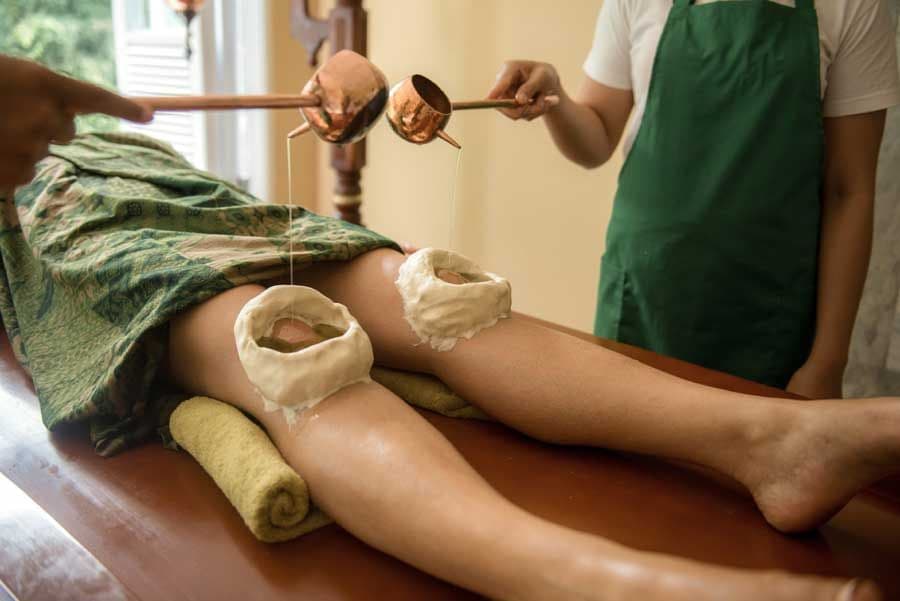
Second the vasti which is locally used, where the medicated oil is kept stagnant for certain period of time in a barrier prepared around the effected part. It is named according to part applied like –
Janu vasti – vasti on knee
Kati vasti – vasti on low back
Greeva vasti – vasti on neck etc.
It is also mainly intended to strengthen the joints, nourishes the joints. Best in osteoarthritis, swelling with association of vata, abhigata (injury to joints) etc.
8 virechana :
It is induced purgation, with herbal compounds. Help to remove the “Ama” in cases like rheumatic arthritis, the metabolic waste can be eliminated. Which reduces the symptoms and intensity of pathology.
9 vamana :
It is induced vomiting by herbal compounds. It is better to remove ama from upper half of the body. More efficient in kapha associated arthritic conditions.
10 Lepam :
Application paste made of herbs, according to the need. There are different herbal combination with different functions like – Vedana hara lepa( herbal paste to reduce pain), Brumhana lepa( herbal paste to nourish), sopha hara lepa( herbal paste to reduce inflammation), Tila lepa, shatahva lepa, gruhadhoomaadi lepam, nagaraadi lepam etc. Paste is applied warm for 30 – 40 minutes according to need and thickness of lepam.
11 Raktha mokshana:
Blood letting in effected joints, especially in Vata rakta is a best therapy. Reduces the vitited rakta and pitta in joint.
Some common Ayurveda herbal medicines
Valiya Ranaadi, Rasna erandaadi, Rasna sapthakam, Citrakaadi, kokilaksham, cheriya rasnaadi, Yogaraaja guggulu, karutha vatu, Gruha dhoomaadi choornam, shatdharana choornam etc
Ksheera bala 101, Dhanwantharam 101, Gandha Tailam.
Vaiswanara choornam, gruhadhoomaadi choornam etc are some commonly used ayurvedic formulations for arthritis.
Diet modifications
The diet control is most important in any arthritis. The Diet will change depending on the dosha involved and the strength of the patient to resist disease.
For gouty arthritis (vata rakta)
1 Grains like barley, wheat, old rice, puffed rice are recommended.
2 Pulses, lentils, pulses, beans are also good.
3 Green leafy vegetables.
4 milk
5 fruits like – grapes, berries, pears etc.
For rheumatic (Amavata)
1 vegetables with bitter taste like – bitter guard, drum stick, brinjal are recommended.
2 Spices like – ginger, pepper, cardamom, clove, garlic are recommended. They have hot potency, which reduces the ama, and improves metabolism.
3 Butter milk with ginger, garlic, curry leaf is also good.
4 Lentils, old rice, barley, ragi are also recommended.
For Sandhivata (osteoarthritis – degenerative conditions)
1 Old rice, wheat, Ragi, barley are recommended
2 Milk is good in degenerative conditions.
3 Meat – highly active animals, wild animals are also good.
4 Oils with omega 3 fatty acids, ghee, coconut oil, olive oil are recommended.
5 Fresh fruits and vegetables are good.
6 almond – good source of vit E, and is a strong antioxidant.
Good healthy diet, timely food with needful exercise are the key to stay away from any kind of joint conditions.
THANK YOU